Combat in Final Fantasy Resonance is classic turn-based commands with one modern loop stacked on top. No ATB bars, no real-time pressure: you pick commands, the timeline resolves, and the depth comes from manipulating that timeline through the break system.
Timeline turn-based battles
Battles run along a visible timeline similar to the Octopath Traveler series: each "turn", every participant on the field takes one action in order, then the next turn begins. You control a party of four characters; everything else on the field acts on its own slot. The official store copy calls these "cinematic battles shaped by smart choices", with dynamic camera work over the pixel dioramas.
The break system
This is the heart of every encounter, and the official description is explicit: "exploit enemy weaknesses to stagger them, breaking their defenses to seize extra turns".
- Hit the weakness. Striking an enemy's elemental weakness drains its break gauge faster than normal attacks.
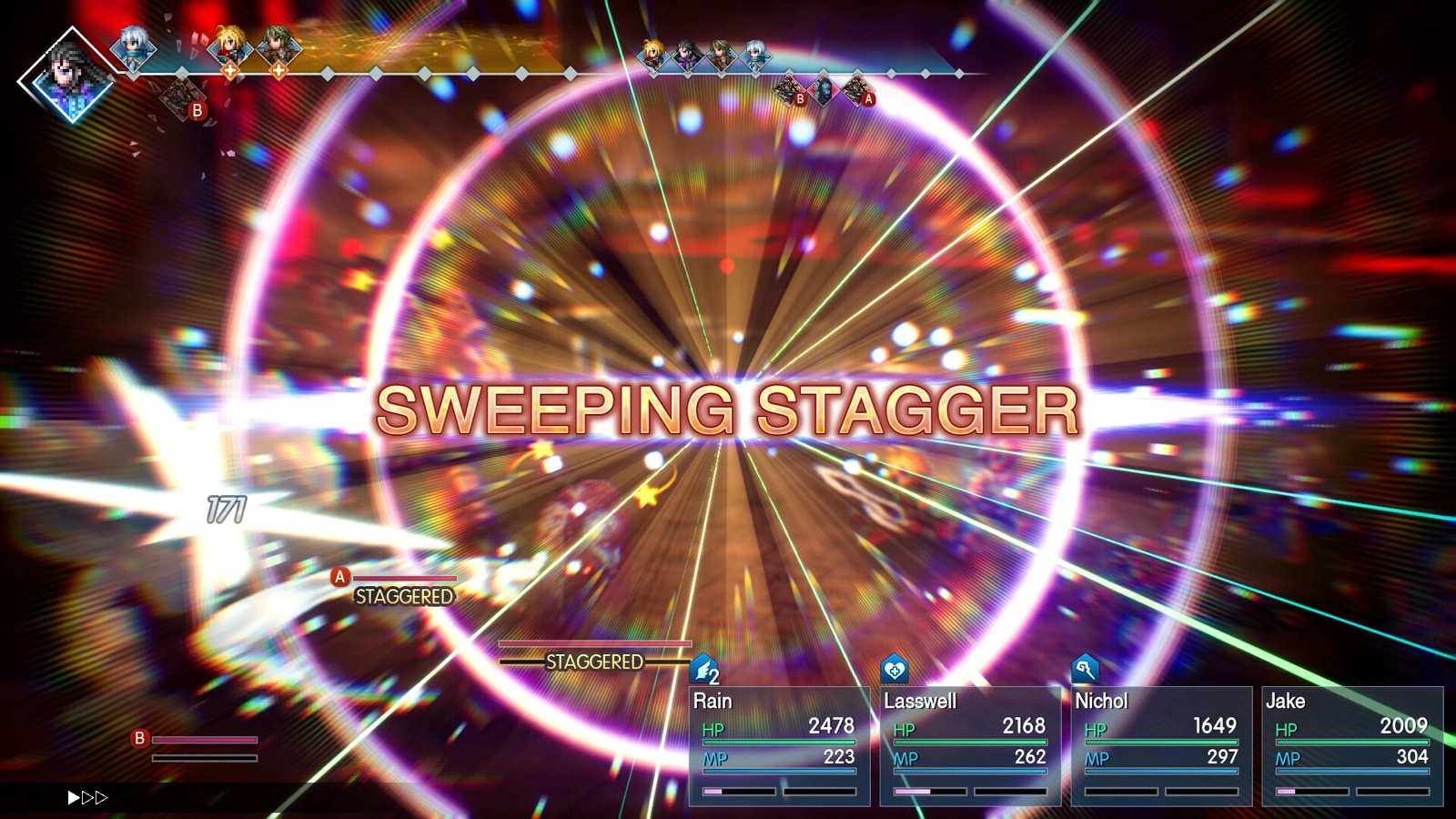
- Break the enemy. When the gauge empties, the enemy is staggered: it loses its action and takes increased damage, while every party member gets a follow-up attack.
- Chain breaks across the field. Enemies recover from stagger as turns roll on, so the skill is timing breaks rather than mashing them.
The break job role exists exactly to empty these gauges fast; party construction around roles is where the strategy lives.
Resonance Ultimates
When every enemy in an encounter is staggered during one turn, a sweeping stagger is triggered, and your equipped vision can perform a Resonance Ultimate: a cinematic, vision-exclusive attack stronger than a limit burst, rendered with full 3D CG for the legacy characters. The official screenshot above shows the moment it fires: gold lettering, both enemies staggered, the payoff for setting up the whole field at once.
Limit bursts and espers
Two more systems layer on:
- Limit bursts. Each character has a limit burst gauge; at full charge they can perform a limit burst, a powerful ability with special properties, the series' traditional limit break equivalent. One deluxe-exclusive burst, Fel Meteor, arrives through the Archwitch's Grimoire.
- Espers. Summons are present in combat. Fina can summon an esper such as Bahamut, which joins the field as a separate, uncontrollable ally that acts on its own for several turns before unleashing its signature attack (Megaflare, in Bahamut's case) and leaving. Hands-on footage also shows Siren as a summon.
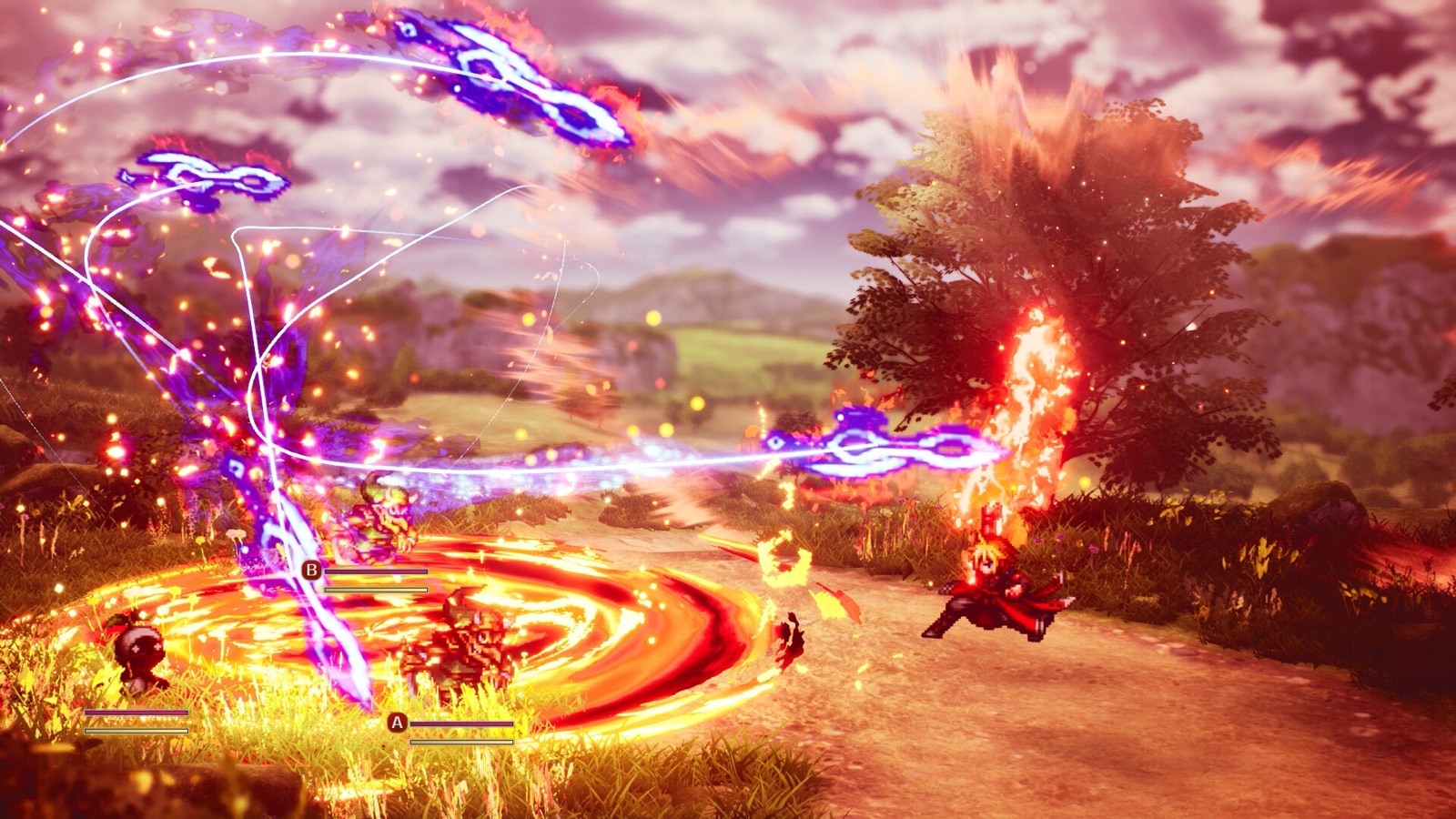
The challenge content where these systems get stress-tested, from the Colosseum ladder to the twelve sealed weapons, is catalogued on the side content page, and the free demo runs this exact loop now.
Difficulty, speed and random encounters
- Two difficulty tiers: casual and normal. The combat director's stated aim is a fair challenge on normal, with casual for players who find classic RPGs too hard; the game compares its normal difficulty to the Octopath Traveler series' baseline and is not aiming to be a punishment game.
- Battle speed can be raised to 1.5x and 2x. The speed controls are visible in the official interface screenshot above.
- Random encounters return, by design. The producer has argued random encounters make dungeons a whole-journey resource challenge rather than a series of isolated fights. Two softeners: encounter rates are tuned down in puzzle areas, and the minimap shifts yellow then red as an encounter approaches, so nothing jumps you without warning.
- Cactuars prowl the game. Defeating one grants large experience, the series' classic jackpot enemy in the Dragon Quest metal-slime tradition.
FAQ
Is Final Fantasy Resonance turn-based?
Yes, fully turn-based command battles on a visible timeline. No ATB, no action combat, no timed inputs: the Steam listing even advertises "playable without timed input".
What is the break system?
Attacking an enemy's weakness drains its break gauge; an empty gauge staggers it, cancelling its action and granting every party member a follow-up attack. Stagger every enemy in one turn and a Resonance Ultimate becomes available.
What is a Resonance Ultimate?
A vision-exclusive super attack triggered by a sweeping stagger, breaking all enemies in a single turn. It is stronger than a limit burst and played as a full cinematic.
Can you turn off random encounters?
Not announced. What is confirmed: lower encounter rates in puzzle areas, and a minimap colour warning before each encounter.
How hard is it?
Two difficulties, casual and normal. The developers compare normal to Octopath Traveler's baseline and describe the goal as a fair, memorable challenge, not brutality.